A century of rainfall records reveals distinct patterns of change across Indian cities
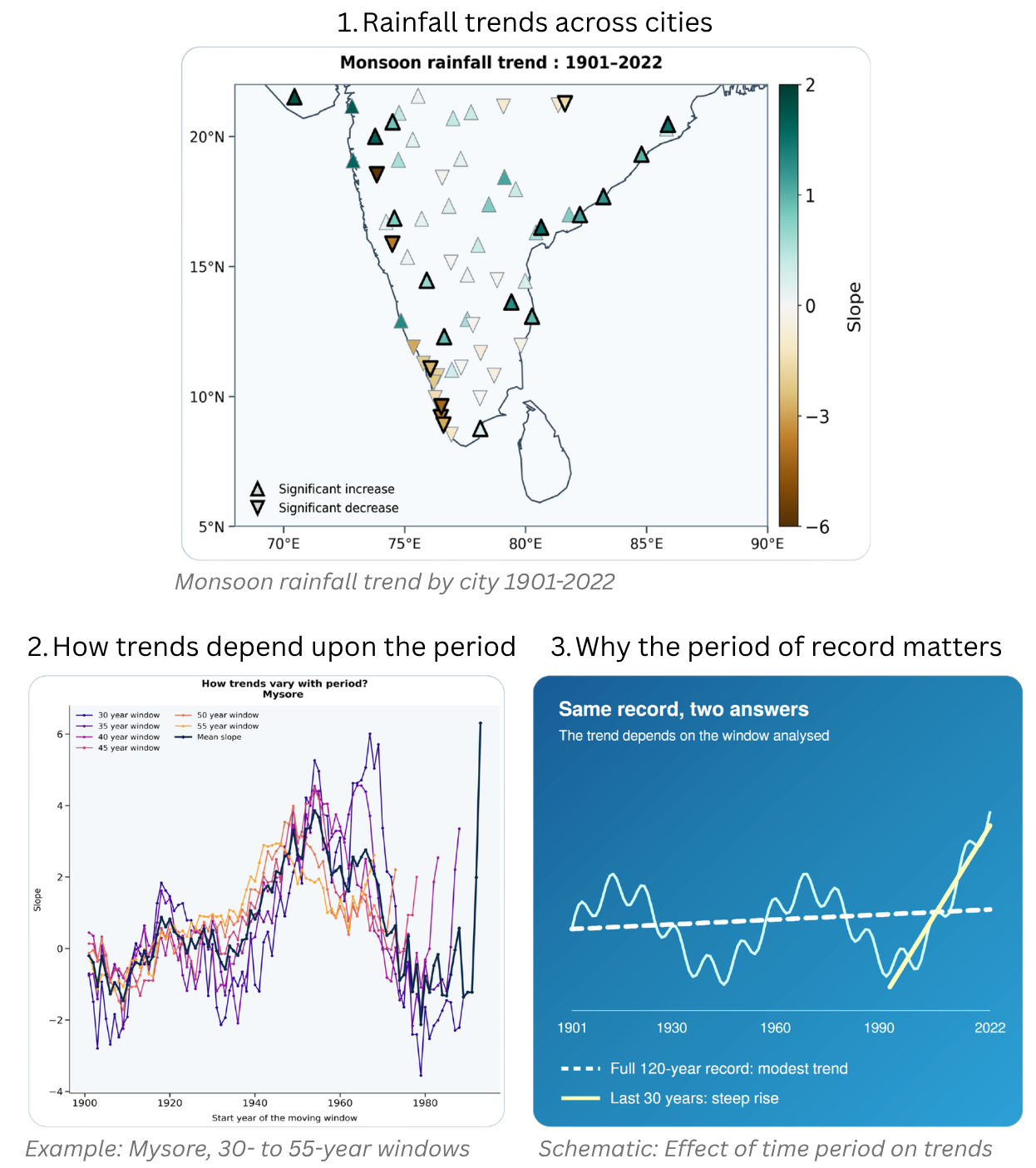
Recent research shows varying trends in rainfall across 63 Indian cities, where the period of record is important. In the image above, panels 1 and 2 are from the study's analysis (IMD gridded rainfall, 1901-2022). Panel 3 is an illustrative example that does not use actual data. Image: RAFT Lab, IITH
A recent analysis of over 120 years of rainfall data across 63 cities in peninsular India reveals significant shifts in rainfall patterns, with annual rainfall decreasing along the west coast while increasing along the eastern coastline. It also identified four distinct patterns of change in rainfall through time across cities.
The study, led by researchers from the RAFT lab at IIT Hyderabad in collaboration with the University of Colorado Boulder, finds consistent north-south differences in rainfall and four main patterns of temporal change across cities. The study’s findings emphasise the need to move beyond simple historic baselines and integrate long-term rainfall variability in urban planning and water resource management.
Over a century of rainfall records
Rainfall patterns are changing across the country, with extreme rains causing devastating floods in some cities, while others are straining under severe water stress. While scientists have tried to quantify this change, studies so far have looked at different areas and time periods using different datasets and methods, revealing inconsistent patterns.
To address this, a recent study from Dr Satish Regonda’s Rainfall-runoff Analysis and Forecasting Tools (RAFT) group at IIT Hyderabad analysed how rainfall patterns have changed across 63 urban areas in peninsular India during the 122 years between 1901 and 2022.
As part of the team’s broader research interest in understanding rainfall and runoff patterns in cities and riverine areas, this study asked: “are rainfall trends representative of long-term changes, or are they influenced by the particular historical period being analysed,” says SR Saipriya, a doctoral student in the RAFT lab and the lead author of the study.
“Are rainfall trends representative of long-term changes, or are they influenced by the particular historical period being analysed?”
Using the Indian Meteorological Department’s data archive, the researchers studied how rainfall varies across a year and within the two monsoonal seasons, and how extreme rainfall events have evolved over the last 120 years. They identified transitional time points in rainfall patterns, examined local and regional rainfall trends, and evaluated how measures of change vary with the time window analysed.
Cities show four distinct trajectories of change
The results revealed that several cities underwent sudden transitions in rainfall patterns between 1950 and 1980. Previous research shows that this time period is associated with changes in the magnitude and periodicity of the El Niño–Southern Oscillation, a global climate phenomenon.
Cities showed four major modes of change. Urban centers such as Bengaluru and Mumbai showed a sharp recent increase in rainfall, while Mysore and Hyderabad showed a more gradual rise. Cities including Mangalore and Surat showed a recent decline in rainfall, whereas Pune experienced a decrease until mid-century followed by an upward trend.
These changes have important implications for urban infrastructure, where historic baselines of rainfall may have been surpassed in some areas, while long-term variability needs to be considered for others. The researchers also found that the size of the time window used for analysis influences the variability in estimates of change.
Historic baselines of rainfall may have been surpassed in some areas while long-term variability needs to be considered for others.
Rainfall trends carry geographic signals
Mapping changes across individual cities shows that annual rainfall and rainfall during the summer monsoon are decreasing in areas along the Western Ghats mountain range, which borders India’s west coast. On the other hand, annual rainfall is increasing in urban areas along the eastern coastline, though it shows a decline in the winter monsoon, which is dominant in the south-east coast. Trends in extreme rainfall did not show consistent regional patterns, possibly reflecting the diverse origins of disturbances causing them, ranging from depressions and low pressure systems to tropical cyclones.
Zooming out, the study grouped these cities based on their rainfall patterns, where southern regions were consistently distinct from the northern peninsula. In the north, a finer sub-division between eastern and western parts emerged for the summer monsoon and annual rainfall extremes.
Long-term trends can inform local policy
The study’s findings tease apart change in rainfall at the level of individual cities, while also picking out large-scale patterns across them. “This has policy implications, since as populations and water demands grow, urban development and expansion must account for water availability, rainfall variability, and flood and drought risks,” says Dr Satish, who leads the RAFT lab. Saipriya adds that “cities cannot plan around a single historic baseline of rainfall, because change in rainfall differs between locations and time periods.”
“As populations and water demands grow, urban development and expansion must account for water availability, rainfall variability, and flood and drought risks.”
This information can be crucial in making localized action plans. “For example, cities experiencing increases in extreme rainfall may need to periodically reassess stormwater drainage capacity, flood management and disaster preparedness. Cities experiencing declining rainfall may need to pay greater attention to water conservation, groundwater recharge, reservoir storage and water-supply planning,” Saipriya explains.
While the long-term data used in the current analysis captures rainfall within roughly 27 km x 27 km cells, the researchers see the possibility of integrating it with fine-scale observations to better capture extreme rainfall events. Another line of inquiry is how land-use changes associated with urban expansion influence local weather patterns over time, particularly urban heat islands and rainfall. Such city-specific climate assessments can inform development plans to strengthen water security and climate resilience.
Reference: Saipriya, S. R., Regonda, S. K., & Rajagopalan, B. (2026). Space-time variability of rainfall attributes across urban agglomerations of Peninsular India and implications for sustainable growth. Urban Climate, 67, 102950. https://doi.org/10.1016/j.uclim.2026.102950