Zooming into a cell’s gatekeeper using a computational microscope
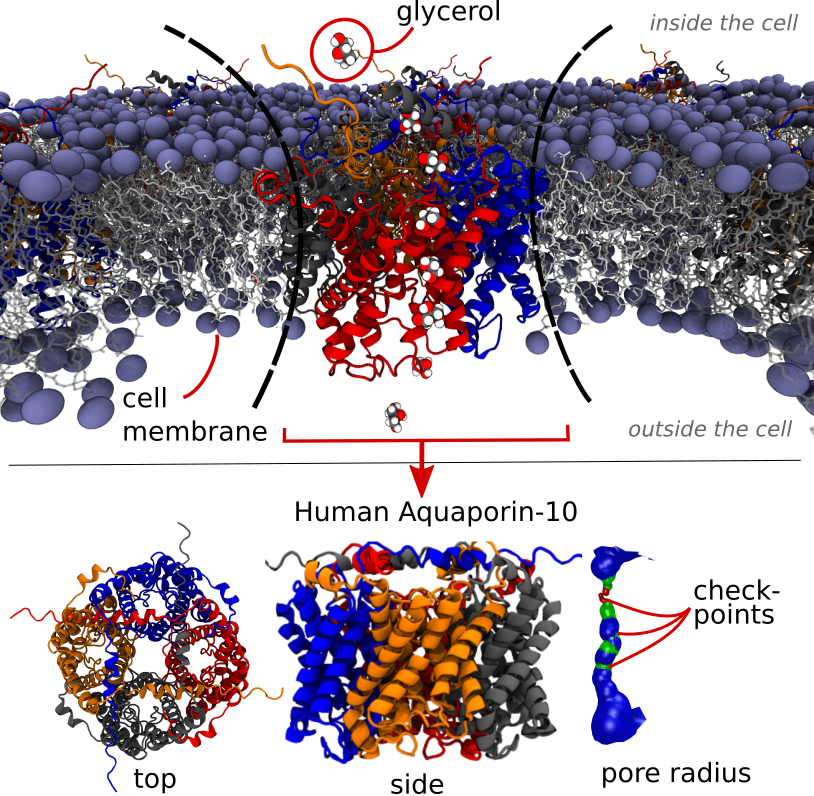
A cell’s surface is a hub of activity, with molecules moving in and out. However, not everything gets a free pass. Proteins embedded in the cell membrane act as gatekeepers, selectively allowing molecules to enter or leave the cell. When these channels malfunction, it disrupts the cell’s molecular balance, leading to disease.
In a recent study, researchers from IIT Hyderabad combined theory and computer simulations to study how a nanometer-sized channel protein, human aquaporin-10 (hAQP10), transports water and glycerol. They discovered that glycerol moves through the channel significantly slower than water, providing the first estimate of glycerol permeability through a single channel. This happens as glycerol interacts with amino acids at narrow constrictions within the channel, overcoming these barriers by changing its orientation. On the other hand, water molecules move through far more easily, facing four times lower energetic resistance.
By providing a detailed mechanistic understanding of selective glycerol transport, the study could inform the development of therapies for diseases linked to hAQP10 dysfunction, such as obesity, diabetes and skin disorders.
Aquaporins are integral to the movement of water and small molecules between the cell and its environment. hAQP10 is a member of the aquaporin family seen in human cells, which selectively transports water and glycerol, playing an important role in osmotic balance and lipid metabolism. Mutations and changes in the expression of these channels are associated with metabolic diseases and skin disorders.
Aquaporins are integral to the movement of water and small molecules between the cell and its environment. When these channels malfunction, it disrupts the cell’s molecular balance, leading to disease.
Previous work described the protein’s structure and offered a static snapshot of how the channel functions. However, “proteins are conformationally flexible and it is important to capture their dynamical aspects,” says Dr Himanshu Joshi, who leads the Molecular Simulation Lab at the Department of Biotechnology, IIT Hyderabad. “The membrane channel is a very tiny object, on the order of nanometers. There are no experimental instruments that can reveal how a glycerol molecule talks to amino acids within it.”
Molecular dynamics simulations act as a “computational microscope”, which helps us peer into nanoscale processes based on the laws of physics and chemistry. Dr Himanshu, along with doctoral student and lead author Kunal Rai, used these models to study how hAQP10 interacts with glycerol and water. “You can stop at any moment to zoom in, zoom out and image molecular movements at the atomic level,” he explains.
The team modeled the movement of each atom within hAQP10 embedded in the cell membrane in the presence of glycerol and water. In a subset of the models, the researchers filled in missing amino acids in the protein’s structure using an AI-based prediction tool. They quantified energy barriers experienced by a glycerol molecule using simulations where it explores various positions along the channel, and estimated its mean first passage time. Finally, they compared the energetics of water and glycerol using molecular simulations where each of the molecules is pulled through the channel’s pore.
Molecular dynamics simulations act as a “computational microscope”, which helps us peer into nanoscale processes. “You can stop at any moment to zoom in, zoom out and image molecular movements at the atomic level.”
The team discovered that the hAQP10 has greater binding affinity for glycerol, which remains in the channel for a mean duration about 100 times longer than water. As it enters the pore, it encounters two narrow passages that act as filters, where the molecule must reorient itself to squeeze through. Next, it encounters a third region, a dynamic gate that changes its conformation on interacting with glycerol before letting it pass into the cell.
These regions act as energy barriers where amino acids transiently bind with glycerol and impede its movement. While the flow of glycerol is modulated by various checkpoints, water molecules pass through the pore far more readily. The simulations also suggest that the movement of glycerol is favoured from outside to inside the cell. The study provides one of the first quantitative measures of glycerol permeability, providing a reference point for future experimental studies.
Glycerol moves through the channel significantly slower than water, as it interacts with amino acids at narrow constrictions within the channel, overcoming these barriers by changing its orientation.
“The pore is very selective; it has to have a language in which to ask whether the right molecule is going through,” says Dr Himanshu. “The glycerol molecule talks to the amino acids [of the channel] using molecular grammar, which gives it specificity. It has to align with the pore, which is a check that sterically allows only a certain orientation of the molecule to pass through.”
Glycerol plays an important role in lipid synthesis, energy storage and osmotic stability. Its transport through aquaporins is crucial for normal cellular function. The study offers insights into the molecular processes underlying glycerol transport, which could help in understanding dysfunctional aquaporins, developing therapeutic measures in associated diseases and engineering synthetic channels.
Reference: Rai, K. & Joshi, H. (2026) Mechanistic insights into cooperative permeation of glycerol and water through Human Aquaporin-10, Proceedings of the National Academy of Sciences, USA. https://doi.org/10.1073/pnas.2606178123