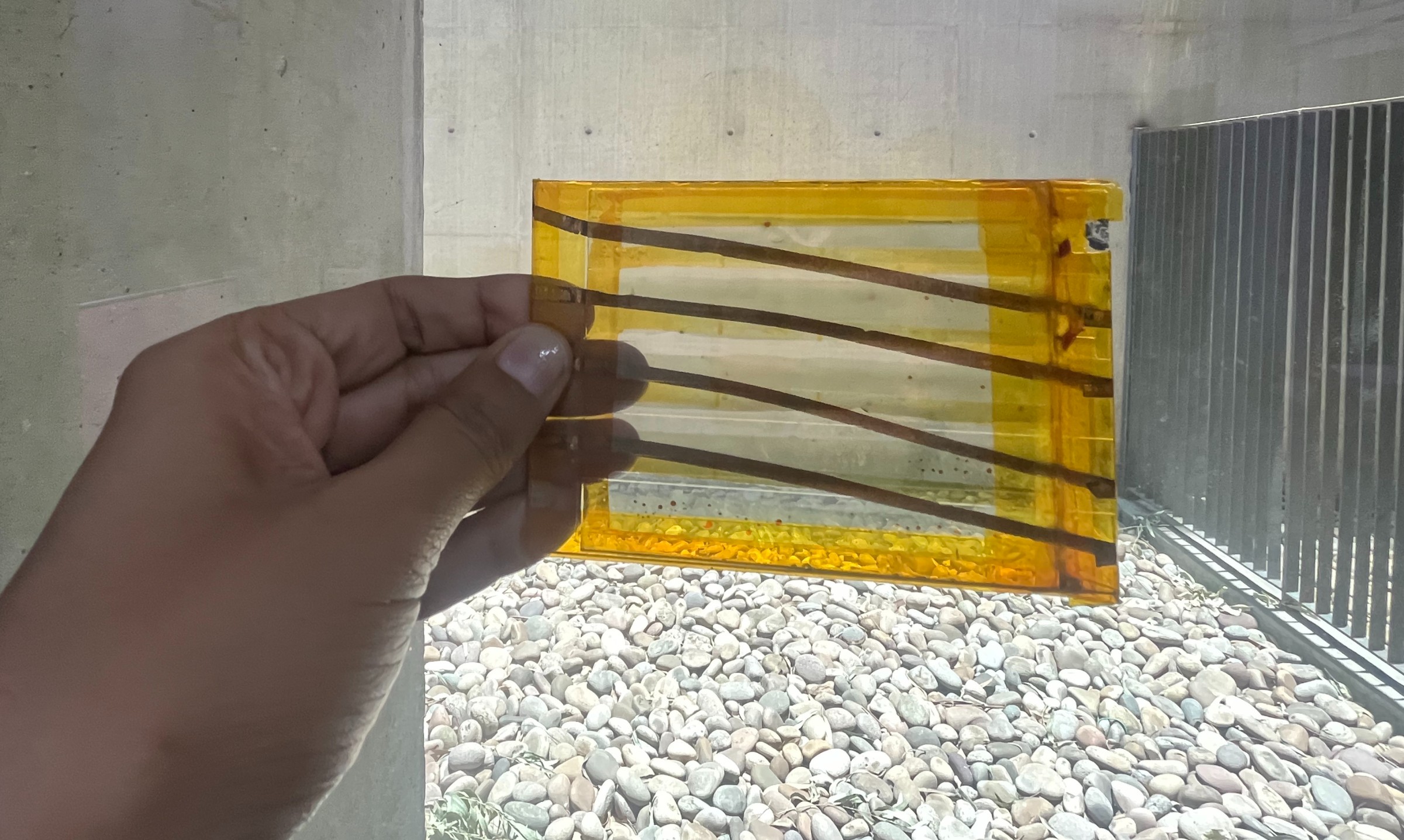
A translucent postcard-sized sheet with alternating gold and dark stripes that can be folded and rolled in any direction. This is not a craft material, but a prototype for the next generation of solar panels.
Pavakah Energy (pāvaka, Sanskrit for solar flare), a start-up incubated in the Indian Institute of Technology Hyderabad (IITH), is using novel materials to develop inks that can be printed into thin-film solar panels. A far cry from the bulky, space-consuming installations, these light and flexible films promise to transform any surface into a solar panel, while reducing the costs of manufacturing and end-of-life recycling.
The next generation of solar panels
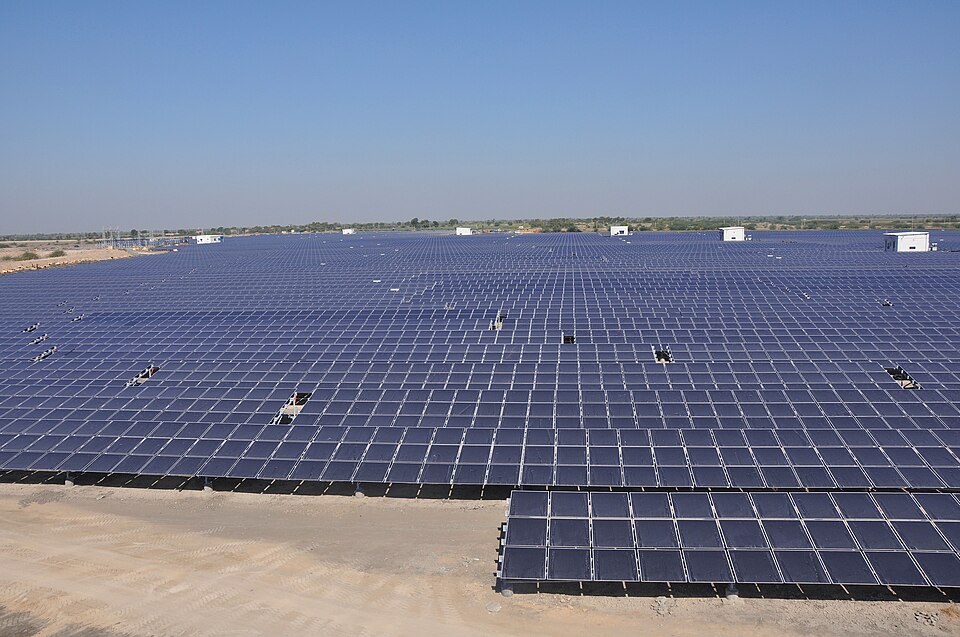
“Clean energy is the need of the hour,” says Vikram Bakaraju, Founder and CEO of Pavakah Energy. The world is looking at renewable energy alternatives to reduce greenhouse gas emissions from fossil fuels, whose supply is threatened by depleting reserves and a changing geopolitical climate. India is the world’s third largest producer of solar power, which makes up close to a quarter of the country’s total energy capacity. This is mainly generated by large-scale solar farms, while household and rooftop installations contribute a much smaller fraction.
India is the world’s third largest producer of solar power, most of it generated by large-scale solar farms using conventional solar panels.
Pavakah Energy aims to develop affordable solar panels that can be deployed across income brackets and integrated into diverse building layouts. “We are working on the third generation solar cells, making thin films that are lighter, flexible, cheaper, and easier to fabricate,” says Vikram, who comes from a background in materials science and nanotechnology. The start-up’s co-founder and COO is Kapardhi Bharadwaj, who runs business operations leveraging many years of experience in energy research and policy. Pavakah’s Head of R&D is Dr Nagabhushan Patel, who has more than a decade of experience working on materials science and semiconductor physics in both academia and industry. The start-up is advised by Dr Ashish Kulkarni from the Department of Chemistry at IIT Hyderabad.
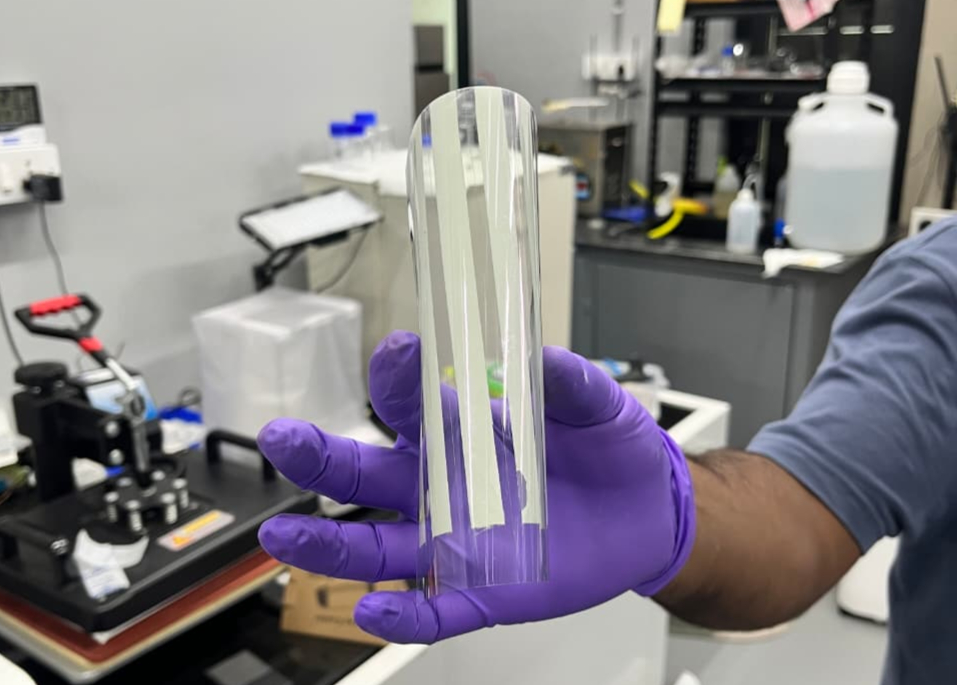
Conventional solar panels are bulky, made of interconnected silicon wafers enclosed within protective layers and mounted on a metal frame. Manufacturing them involves extensive processing, and recycling them to recover constituent materials is energy-intensive. They can also be prohibitive for many households due to space and cost constraints.
Pavakah Energy using novel nanoparticle-based inks to print thin-film solar panels that can be integrated into a wide range of building surfaces.
The alternative being developed by Pavakah Energy uses inks made from nanoparticle suspensions that are printed on a glass or plastic substrate. A key ingredient in these inks is a class of crystalline materials called perovskites, metal-halide compounds known for their efficiency in harvesting solar energy. To make a solar panel, the different components of a solar cell are coated sequentially as thin films, connected, and encapsulated. The manufacturing process is simpler and cost-effective.
The film is thinner than a strand of hair, and the entire panel is only a few millimeters thick. These translucent solar panels can be integrated into a wide range of built surfaces, such as windows and building facades.
“It can be fabricated with much less energy,” says Vikram. He adds that the film can also be peeled from the substrate to extract materials for recycling. “A circular economy is very important for a country like India, where we lack access to critical minerals, have limited processing capabilities, and face import restrictions.”
Thin-film solar panels can be fabricated with much less energy, where the film can be peeled from the substrate to extract materials for recycling.
Pavakah Energy has developed a prototype demonstrating competitive efficiencies in the lab. “We are now working on a pilot product that can be taken to the real world. We are developing a full stack of technologies to support Building-Integrated Photovoltaics Technology adoption for the market,” explains Vikram. “There are a few challenges that need to be tackled in the lab before we bring it out, which is what we are doing now.”
Where the science happens
The start-up’s research facility, which began in a makeshift shed on campus, is now housed at iTIC, IIT Hyderabad’s deep-tech incubator. The lab has a highly controlled clean-room environment where the team synthesises inks, prints thin films, and fabricates solar cells while minimising contamination. This requires concerted efforts by team members with expertise in chemistry, physics and engineering.
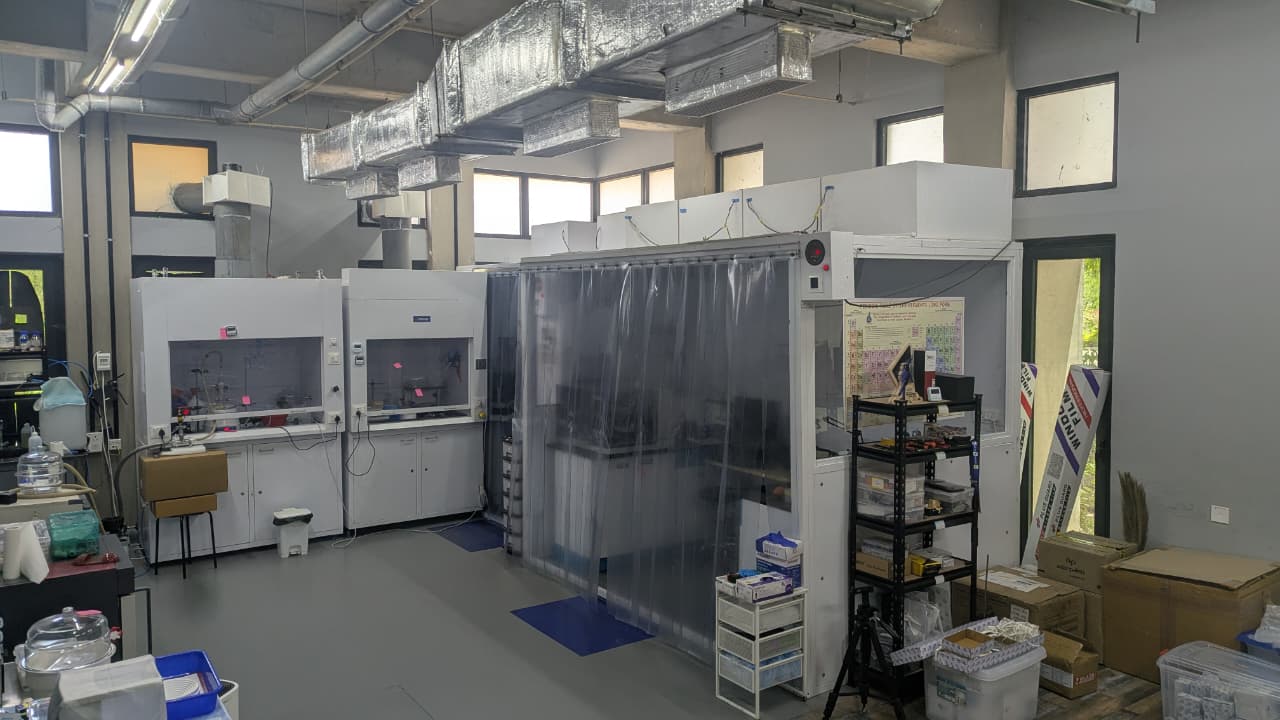
The Pavakah Energy team brings together expertise in chemistry, physics, materials science and engineering to develop the next generation of solar cells.
The process can be very time-consuming, involving multiple steps that require careful attention to detail, says Sandeep Srivastav, a materials scientist who formerly worked at Pavakah Energy.
While working with hazardous materials to synthesise the ink, “we have to be very careful to protect ourselves and the environment,” says Vasu Katari, who joined Pavakah after his MTech in Chemical Engineering from IIT Hyderabad. Along with materials scientist Dr Priyank Sham, he optimises the ink so that it is stable and has the right concentration and consistency needed for the downstream steps.
“We follow solution-based processing,” to make the solar panel, says Gayathri Nambiar, who works alongside Sandeep in fabricating the device. A solution of nanoparticles is coated on a substrate using specialised printers, annealed into a thin film, which is followed by the next layer. “All of this happens in the clean room.”
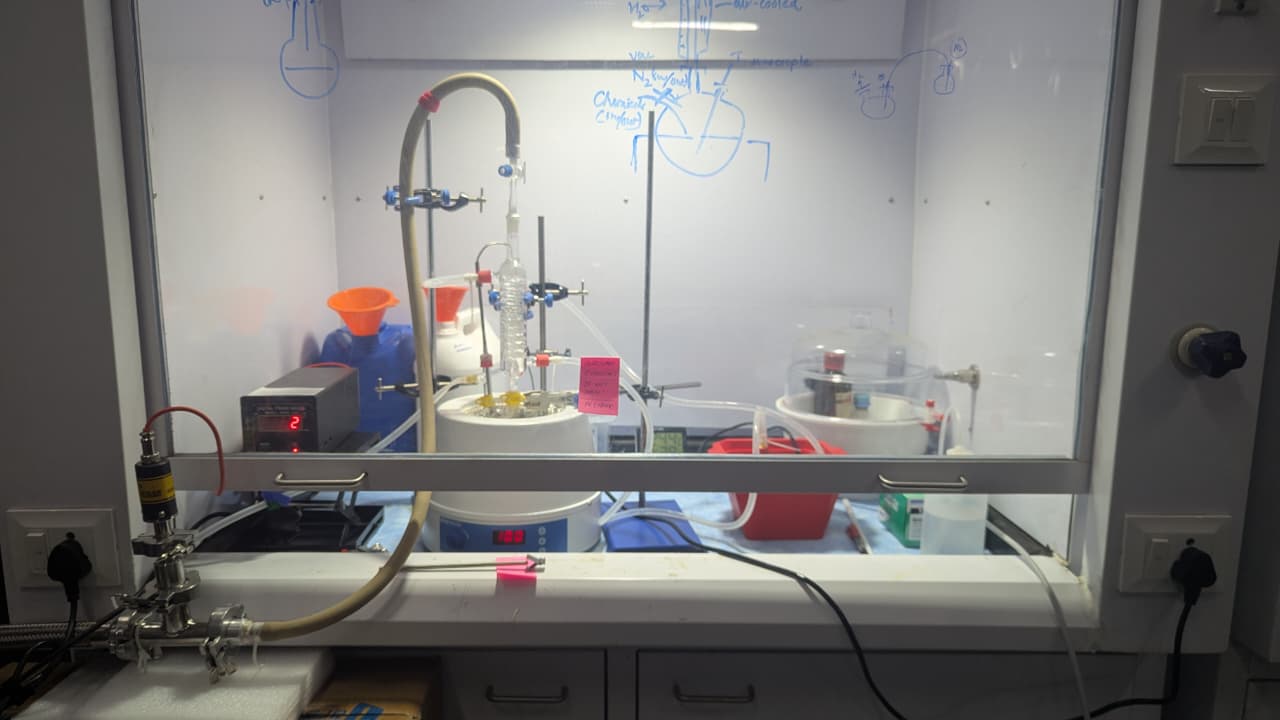
“We currently have a Class 1000 clean room,” explains Sandeep, where airborne particles do not exceed a thousand particles per cubic foot of air. This is critical because even small impurities introduced during synthesis can drastically reduce the efficiency of solar cells. Despite using an advanced air filtration system and protective gear, humidity and dust pose a stubborn challenge.
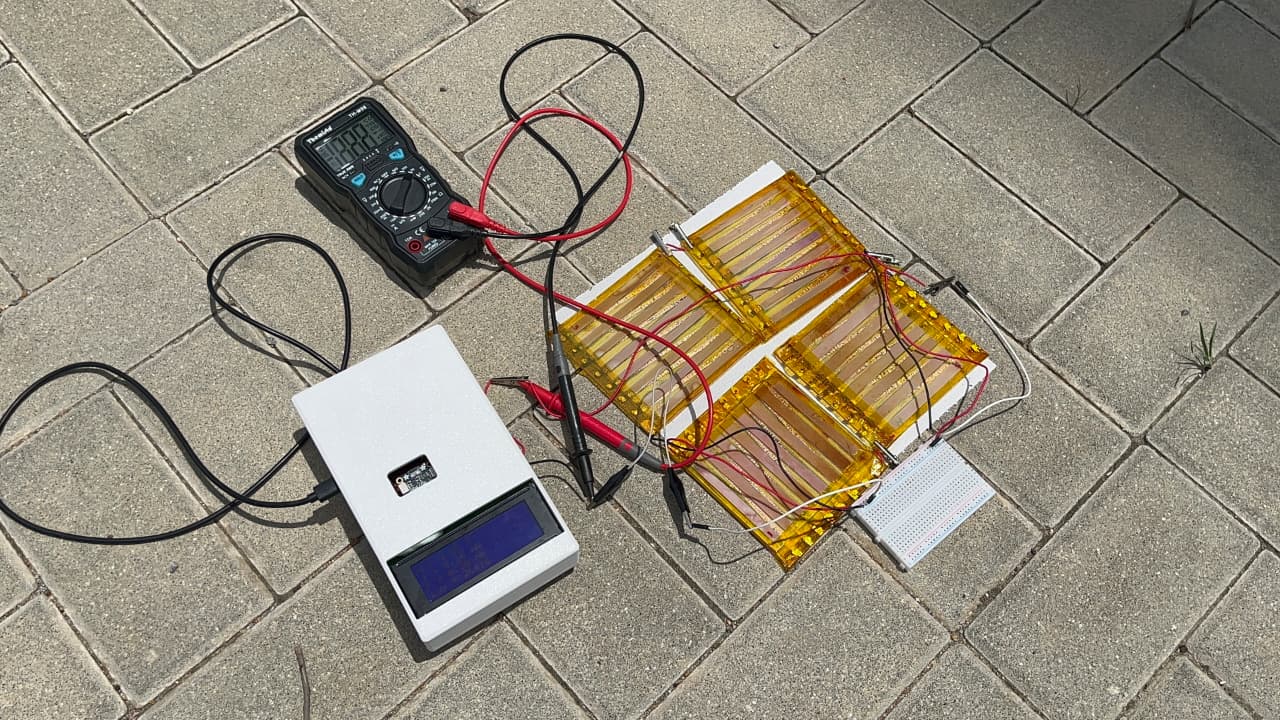
Once the thin-film solar panel is fabricated, its performance is evaluated indoors and in the field to measure device efficiency and optimise output
Once the thin-film solar panel is fabricated, its performance is evaluated indoors and in the field under various light conditions. Saaya PS, a recent engineering graduate, who previously worked at Pavakah Energy contributing to measuring device efficiency and optimising output. She was also involved in developing a handy tool called the Built Area Energy Model, which can calculate a building’s solar energy potential based on its location and surface area.
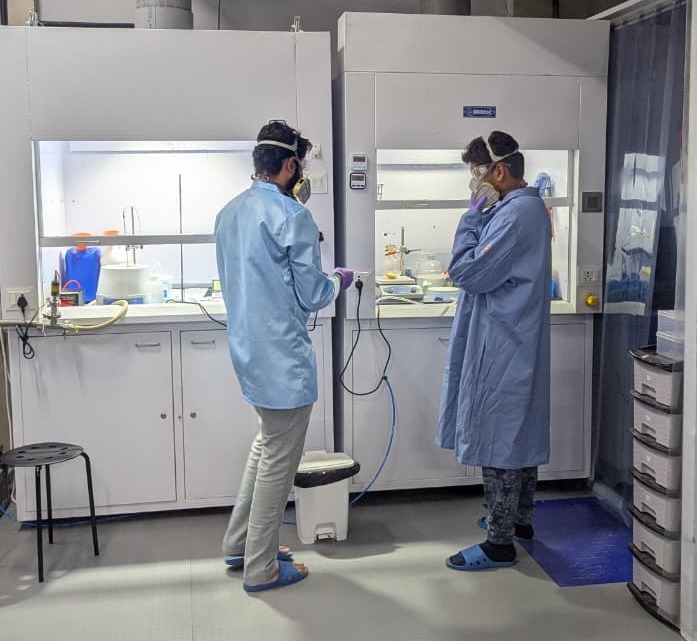
Across all of these production stages, there is considerable overlap in the team’s work, requiring careful planning and coordination. “Everybody’s work is connected. It is like a chain,” says Sandeep. “That is when team work and project management becomes important,” adds Vikram.
“The goal is to help develop a product that is useful for society,” says Vikram. “This year is all about scaling up operations and taking the product to the market,” he adds. “It is exciting but also scary. This year will tell us where we are and how much we need to work to get to where we want to reach.”