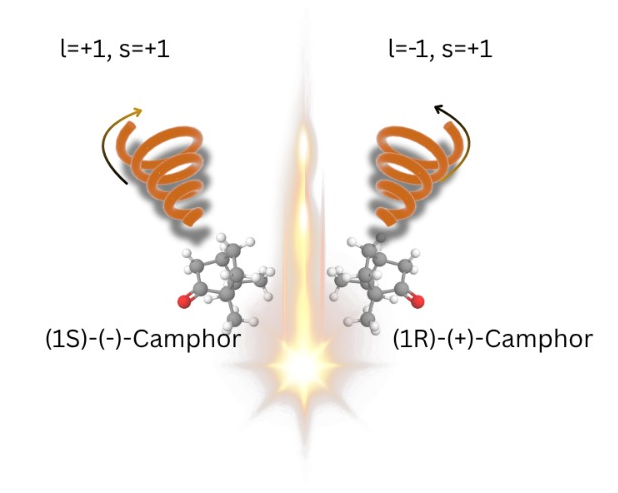
Many molecules in nature occur as twins that are mirror images of each other. Think of left and right-handed cricket gloves, which look identical but cannot be perfectly aligned one on top of the other, however one may rotate them. This property of ‘handedness’ is closely tied to the function of molecules, making its characterisation important in chemical industry and molecular diagnostics.
Researchers from Prof Vandana Sharma’s research group at the Indian Institute of Technology (IIT) Hyderabad, along with collaborators from the Tata Institute of Fundamental Research Hyderabad and IIT Bombay, have developed a new method that can tell apart mirror-image molecules more efficiently. In this method, a sample exposed to laser pulses with specific structural properties generates molecular fragments that offer clues to the chemical’s handedness. This new technique is more sensitive than existing approaches, requires smaller sample quantities and minimal processing, making it attractive for practical applications.
Many molecules exhibit chirality, existing in two different forms that have the same chemical formula but differ in their spatial orientation.
For example, most amino acids occur as two mirror-image forms, of which only the left-handed form binds efficiently to the enzymes that synthesise proteins in living organisms. Much like trying to fit one’s right hand into a left-handed cricket glove, molecules with mismatched handedness often do not fit together properly.
The chirality of a molecule, therefore, is intimately tied to its chemical and biological properties. Currently, various techniques are used to ascertain the chirality of a molecule in drug development and chemical industries. Many of these suffer from low sensitivity, requiring the use of large sample amounts, while others need laborious sample preparation.
The new method, promising improved sensitivity, is based on the principle that mirror image molecules interact differently with certain structural properties of light.
These properties are related to the spin (spin angular momentum) and a helical twist (orbital angular momentum) of light, which also exhibit handedness. As a result, when the chirality of a molecule interacts with the handedness in light, it produces different responses.
In their experiments, the research team probed chiral samples of camphor using twisted femtosecond laser pulses to ionize and fragment the molecules. They measured the mass and abundance of these fragment ions under opposing light conditions, and calculated an index to compare the ion yields between them. The scientists found that this index reverses its sign between molecules of opposite handedness, offering a reliable method for detecting chiral forms.
While traditional optical methods primarily use the spin of light to detect chirality,
the current method combines spin with a helical twist in light to enhance the detection sensitivity by up to four-fold.
The signal can be further enhanced by tuning the duration and intensity of light pulses. The technique also reduces noise by analysing samples in the gas phase, minimising interference from other materials such as solvents and substrates. Given the need for small amounts of sample with minimal processing, this method offers a fast and scalable approach for chemical and biological sensing.
Reference: Venugopal, H., Aravind, P., Sajeevan, A., Sen, S., Sinha, A., Giri, S., Dixit, G., Gopal, R., & Sharma, V. (2026). Enhanced chiral discrimination in mass spectrometry with orbital angular momentum beams. Science Advances, 12(23), eaec6549. https://doi.org/10.1126/sciadv.aec6549