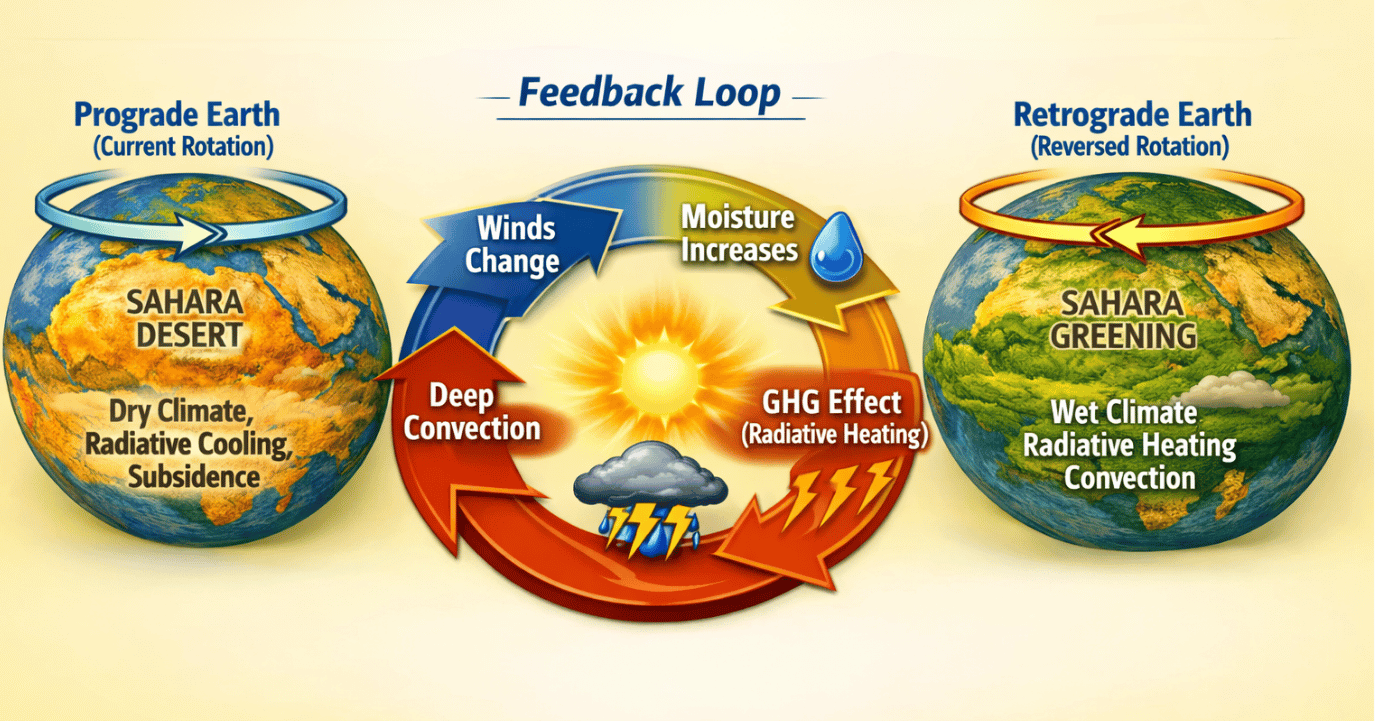
Have you ever wondered what might happen if the Earth reversed its spin? In a recent study, researchers used simulations to discover its dramatic effects – monsoon emerges over one of the world’s largest deserts.
Their experiment reveals hidden links between the Earth’s rotation and atmospheric energy balance, which shapes global climate. The study places water vapour at the centre of this relationship, showing that its dynamics are crucial in controlling heat exchange in the atmosphere, which drives the monsoon.
The study was carried out by Dr Chetankumar Jalihal from the Department of Climate Change, Indian Institute of Technology, Hyderabad, and Dr Uwe Mikolajewicz from the Max Planck Institute of Meteorology, Hamburg.
What makes the monsoon?
“Monsoons depend on multiple aspects of the atmosphere,” says Dr Chetan. It involves the transfer of energy through radiation, phase changes between water vapour and water, and atmospheric fluid flows. These processes often occur simultaneously and are tightly coupled, making it challenging to tease apart their roles.
Early explanations of the monsoon attributed it to greater heating of land during summer, which creates low pressure that draws in moisture-laden winds from the sea. However, that is only part of the picture. More recent theory invokes energy differences in the atmosphere, which move around heat and moisture that shape the monsoon. The current study looked at how the atmospheric energy balance differs between regions with contrasting climates.
When energy in the form of solar radiation reaches the Earth, part of it is reflected back to space, while the rest may get trapped in the Earth system. This can happen when clouds high up in the sky act as a blanket holding outgoing heat and warming the atmosphere. Even in the absence of clouds, water vapour acts as a powerful greenhouse gas, much like carbon dioxide or methane, that absorbs and re-emits heat.
The balance sheet of energy in the atmosphere, influenced by factors such as reflectivity, clouds, and water vapour, is measured by top-of-atmosphere radiation budget. This is the difference between incoming solar radiation and outgoing energy from the Earth. “When there is a lot of energy going into the atmosphere, you have to have a system to take it away,” says Dr Chetan. “That is what creates the monsoon.”
Rotational reversal is revealing
During the monsoon season from June to August, the top-of-atmosphere budget is positive over regions in South Asia that receive rainfall, while it is negative over the Sahara desert. This difference was earlier thought to be driven by the reflection of sunlight by bright desert sand and the lack of cloud cover, leading to a negative energy budget.
“However, the latitude at which the Indian monsoon is seen is the same as the Sahara,” says Dr Chetan. “During the non-monsoon period, the temperatures in India and the Sahara are also similar. It is only the monsoon, which is the exception,” he points out. This made the team think there must be something else apart from reflectivity that shapes the Saharan climate. The answer was revealed by processes set into motion when the direction of Earth’s rotation is reversed.
To understand how Earth’s rotation influences climate, they used results from a complex Earth system model that incorporated atmospheric and oceanic circulation along with biological feedbacks. They tracked how the climate evolved in this model with reversed Earth rotation and compared it with a control simulation in which the rotation remained unchanged. The reversal revealed something that was unexpected.
Greenhouse effect of water vapour makes the Saharan monsoon
In the first summer after the rotation reversal, rainfall increased over the Sahara, rising sharply over the first ten years and reaching an equilibrium at about a hundred years. The top-of-atmosphere energy budget showed a similar sharp increase in the initial years, despite reflectivity remaining the same. Gradually, rainfall spurred the growth of vegetation, which covered the barren Saharan landscape and decreased reflectivity over a prolonged period of time.
“We were surprised by the results showing increasing rainfall over the Sahara. We are used to thinking that mountains, like the Himalayas, are important for the monsoon to exist,” says Dr Chetan. “Our results pointed to something else that was more important.”
Changing the Earth’s rotation affects large-scale patterns in atmospheric circulation. As a result, water vapour converges over the Sahara, and given its greenhouse properties, traps outgoing heat. This turns the top-of-atmosphere energy budget positive, which further attracts moisture, leading to the formation of clouds that strengthen the monsoon. Vegetation also contributes to the energy budget by reducing the reflectivity of the land surface, but with a smaller and more gradual effect on the energy budget. These results showed that water vapour is more important than surface reflectivity in tipping the atmospheric energy balance that drives the monsoon.
“If I push enough water vapour into a certain region, even if it is a desert, I can trigger a monsoon by trapping a lot of energy in the atmosphere. Once clouds form, they stop the energy from going into space, and other feedback systems take over. But initially, it is the water vapour that does the job,” explains Dr Chetan.
New perspectives
Recent research, such as the current study, is trying to combine energy with thermodynamics and fluid flow to understand the monsoon. “Typically, the monsoon has been thought of as an isolated system,” says Dr Chetan, where scientists have studied the influence of external factors, such as the El Niño-Southern Oscillation cycle or the Indian Ocean Dipole. Climate scientists are increasingly looking more closely at how processes internal to the monsoon, such as aspects of the atmosphere’s energy budget, drive this system. “That’s the direction in which the community is moving.”
Reference: Jalihal, C., & Mikolajewicz, U. (2026). Energetics of monsoons and deserts: Role of surface albedo vs water vapor feedback. Earth System Dynamics, 17(2), 319–331. https://doi.org/10.5194/esd-17-319-2026