Physicists model flocks of birds in flight and bacteria swimming in a pool of nutrients to understand the emergence of collective behaviour. These are examples of active matter systems, where individual elements in a group consume energy from the environment to move and perform mechanical work.
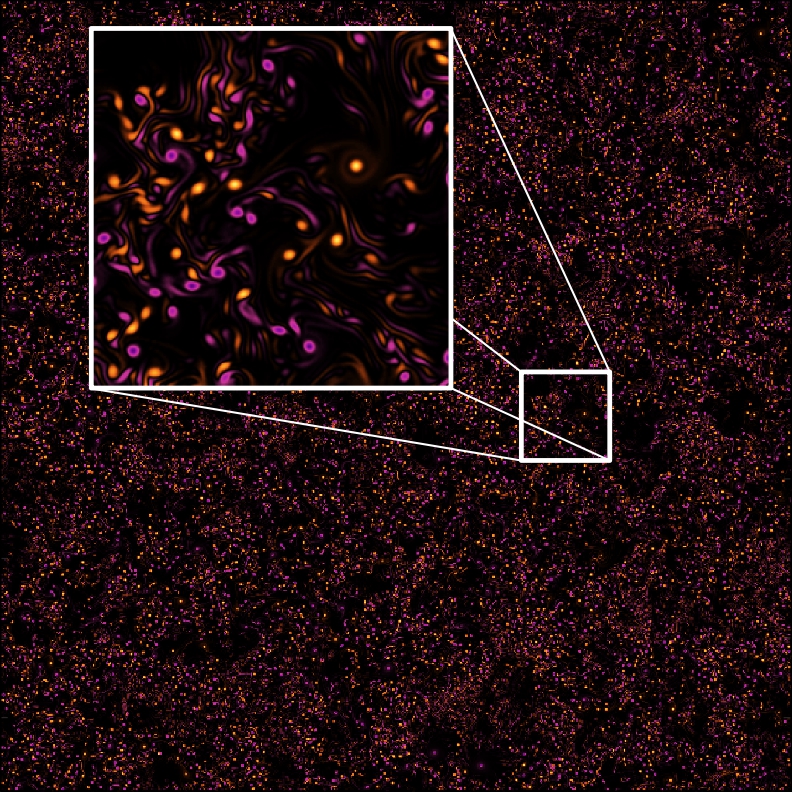
A recent study identified the critical conditions under which the movement patterns in a bacterial suspension transition to a state where order coexists with chaos. Zooming in on these fluids, one would see swirling whirlpools in some pockets, interspersed with irregular and chaotic motion in others.
“Our work provides a new framework for understanding how living fluids organize and transport material,” says Dr Anupam Gupta, an author of the study and a faculty in the Department of Physics, Indian Institute of Technology Hyderabad. The other authors of the study are Kirti Kashyap, a PhD student from IIT Hyderabad, and Dr Kolluru Venkata Kiran from the Institut de Physique de Nice. The team’s findings help us understand how nutrients and other molecules move within organisms and ecosystems.
The flow of a fluid depends on its speed, its properties, such as viscosity and density, and the size of the space through which it flows. These factors determine if the fluid will flow smoothly or become turbulent. Turbulent flows are irregular and chaotic, which makes them difficult to predict. Storm winds and plumes of smoke are some examples of turbulent flow that we see around us.
A dense bacterial suspension can also be seen as a fluid in which the propulsion of millions of individual cells shapes the flow. Here, the resulting motion differs from classical turbulence in some important ways. It does not show wide-ranging fluctuations in velocity, and the distances over which interactions occur are much smaller.
“In conventional turbulence, an external force creates a disturbance that eventually dissipates after losing energy. For example, when you stir a cup of coffee, it generates patterns that are turbulent in nature, which disappear after some time,” explains Dr Anupam. “Whereas, if you think of turbulence in bacterial suspensions, the energy is generated from within the system in the absence of an external driving force. The disturbances are very different between the two systems,” he adds.
However, a few years ago, researchers discovered that dense bacterial suspensions switch patterns of flow based on the activity of the individuals. Beyond a critical threshold of activity, their motion resembles classical turbulence. The new study by Dr Anupam and co-authors pinned down why this universal behaviour occurs.
The researchers ran computer simulations that used models of motion in bacterial suspensions. In these, they systematically increased activity and studied how the emergent flow varies in space.
Beyond a critical threshold of activity, large-scale variations in flow patterns appear within the suspension. There are areas with isolated intense spiraling vortices where the flow is highly ordered and correlated over long distances. Outside these vortices, the flow is disordered and chaotic. Because of the coexistence of ordered and chaotic regions, the distribution of flow speed changes. Instead of being centered around zero, there is a peak in a finite speed in the high-activity regime.
“Turbulent flows generated by swimming bacteria can look completely chaotic,” says Dr Anupam. “We show that at high activity, they secretly organize themselves,” he adds. “The beauty of this is that the switch can be observed qualitatively. You just need to look at the vorticity field, and you can easily see that a large-scale structure starts to appear.”
In the present work, the researchers discovered that the switch in flow is shaped by an interaction between two energy parameters, the activity of the bacteria, and destabilizing forces generated within the system. “We defined a quantity from these energies, which can tell us if there will be a transition or not,” says Dr Anupam. This interplay of energies underlies the universal behaviour in which the flow generated by swimming bacteria resembles classical turbulence.
Taking their findings forward, the group is interested in using bacterial suspensions to study superdiffusion, where particles spread faster than normal diffusion. Dr Anupam’s lab is also interested in studying how viscoelasticity, where a material behaves as a liquid or solid based on the applied force, influences the movement of bacteria.
“Viscoelasticity has been central to most of my research,” says Dr Anupam. “The current study was accidental. When I started looking at the effect of viscoelasticity on bacteria, I realised that we need to understand bacterial turbulence better,” he adds.
“By linking flow structure, statistics and energy balance, our work provides a new framework for understanding how living fluids organize and transport material.”
Reference: Kashyap, K., Kiran, K. V., Gupta, A. (2026). Emergence of local ordering and mesoscale giant number fluctuations in active turbulence. Physical Review Letters, 136(108301). https://doi.org/10.1103/ylbh-8v74