Quantum mechanics describes phenomena at really small scales, such as the behaviour of atoms and particles within them. Usually, the quantum effects of such tiny entities are not visible at scales relevant to humans.
“This is because of decoherence,” says Dr Manisha Thakurathi, who leads the Topological Quantum Matter Lab in the Department of Physics at IIT Hyderabad. “This is similar to a large number of people in an auditorium clapping at random, which does not have a coherent signal.”
Physicists usually use quantum mechanics to describe phenomena at sub-atomic scales, and classical theory, including Newton’s laws of motion, electrodynamics and thermodynamics, at larger, macroscopic scales.
In an exciting discovery, scientists built a macroscopic system, an electrical circuit a few millimetres in size, that could exhibit quantum behaviour. Strikingly, the device behaves as a single macroscopic quantum object rather than as a mere collection of many independent microscopic quantum effects.
This work earned Prof John Clarke from the University of California, Berkeley, Prof Michel H Devoret and Prof John M Martinis from the University of California, Santa Barbara the 2025 Nobel Prize in Physics. Their electrical circuit demonstrated the surprising phenomenon of ‘quantum tunnelling’, where particles slip through a barrier even when they lack the energy to surmount it. As predicted by quantum theory, the system also shifted between discrete energy levels by gaining or losing specific amounts of energy.
The experimental set-up developed by Clarke, Devoret and Martinis offers a means for probing quantum phenomena at a tractable macroscopic scale. The quantised energy levels of the system are also being explored to store information, forming the basis of quantum computers.
The Josephson junction
An essential component of their electrical circuit was a Josephson junction, where two superconductors are separated by a thin insulating barrier.
Superconductors are materials that conduct electricity without resistance below a very low critical temperature. At the microscopic level, electrons in these materials, which normally repel each other, become coupled by interacting with vibrations in the material’s crystal lattice. The collective flow of these coupled electrons leads to superconductivity.
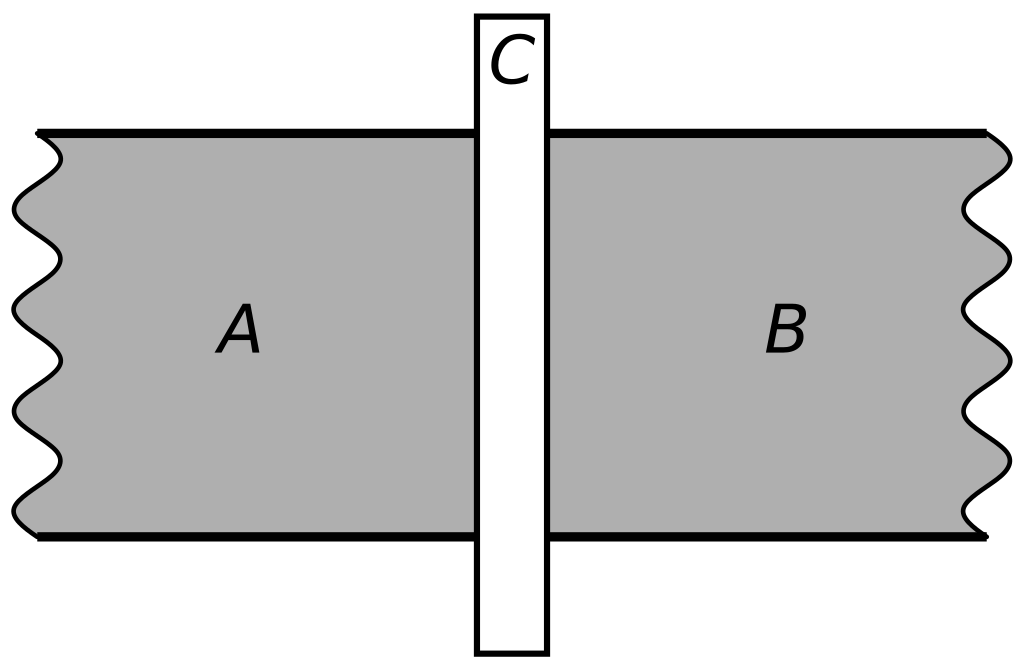
If an insulating material is placed between two superconductors, one would expect it to impede the flow of electrons, so that no current passes through. However, in the early 1960s, physicist Brian D Josephson showed otherwise. He demonstrated that an electric current passes through a thin insulating barrier even when no voltage is applied.
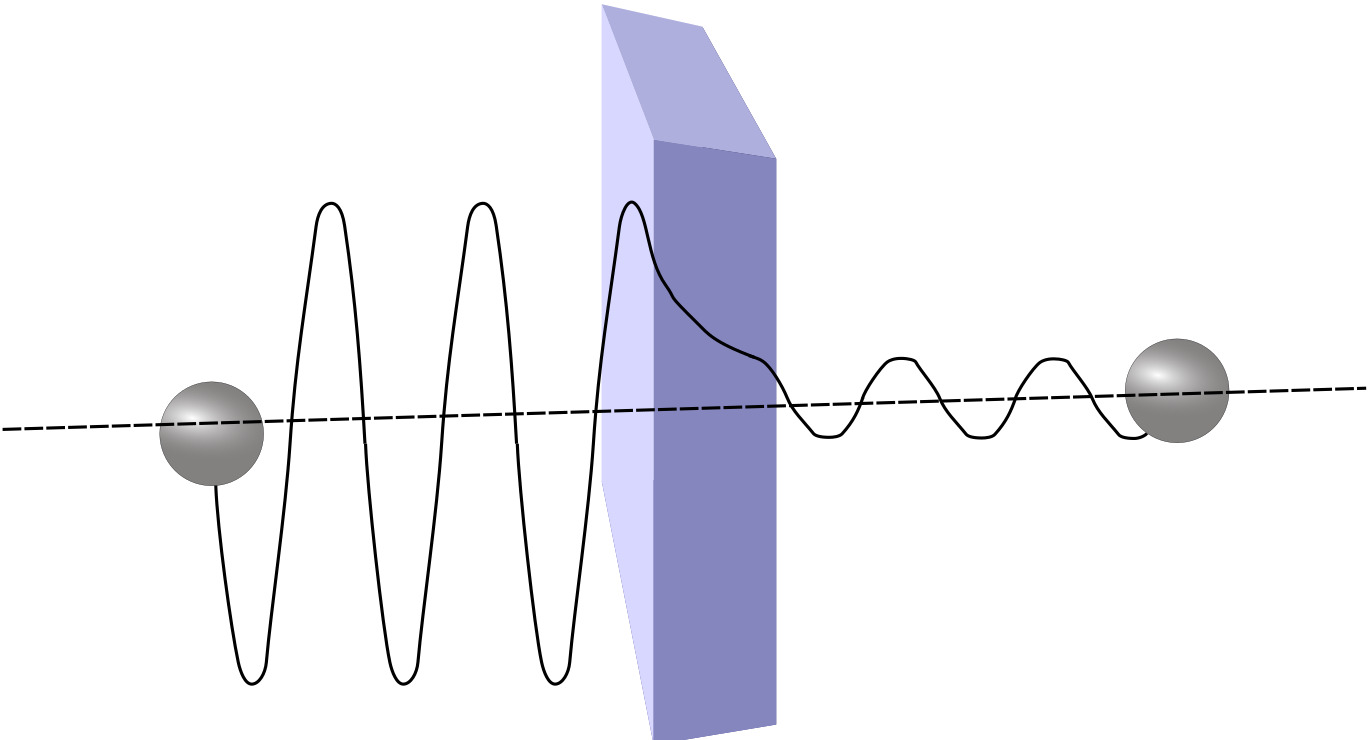
This happens because the coupled electrons behave like waves, as explained by quantum mechanics. The system is described by a single wave function, which evolves over time. When such a wave hits an energy barrier, such as the thin insulating layer, there is a small probability that part of it can penetrate and pass through the barrier. This phenomenon is known as quantum tunnelling.
“If I want to throw a ball across a wall and put in enough energy, it will cross the wall. But if I do not throw it with sufficient energy, it will hit the wall and bounce back towards me,” explains Dr Manisha. “Now imagine a quantum scenario. Think of the particle as a wave that is traveling, and a barrier comes in the way. The wave can pass through with a small but non-zero probability.”
The experimental set-up
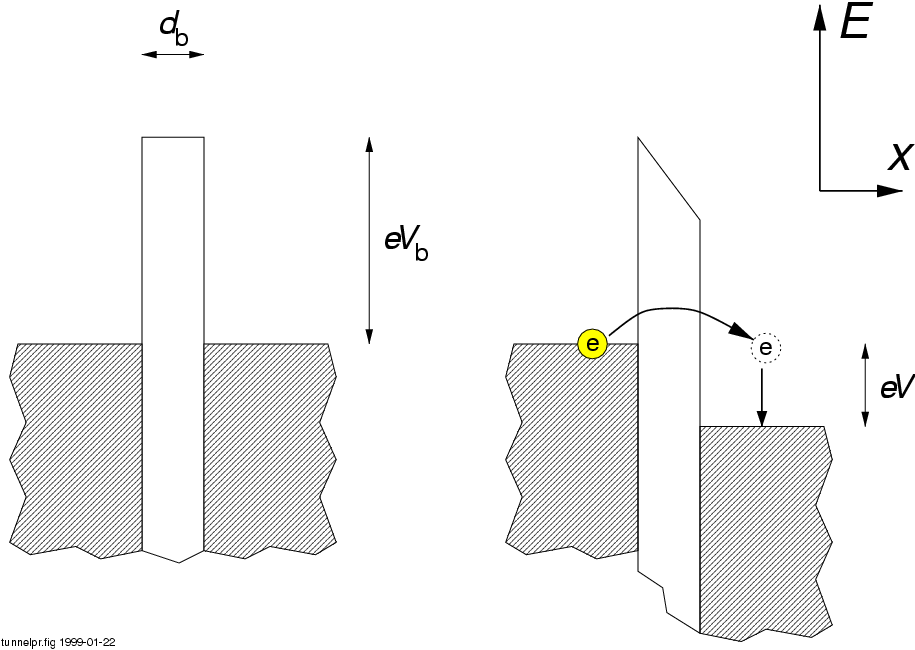
In the 1980s, Clarke, Devoret and Martinis used a Josephson junction made from two superconducting materials, Niobium and Lead-Indium, separated by an insulating layer of Niobium Oxide. This was connected to a power source, where a small current was passed through the junction, and the resulting voltage was measured.
Initially, the voltage was zero because of the insulating barrier. However, over time, quantum tunnelling of coupled electrons would cause a voltage to appear. This voltage could also arise when electrons absorb heat from the environment to leap across the energy barrier. To tell these possibilities apart, the researchers monitored the system while gradually cooling it to very low temperatures, minimising its thermal energy so that the quantum effects prevailed. Given the small probability associated with tunnelling, they repeated the experiment several times and made multiple measurements.
The scientists also used microwaves to excite the system. When the system absorbed a specific amount of energy, it jumped from a low energy level to a higher one, increasing the probability of tunnelling. Experiments showed that the energy levels at which these transitions occurred corresponded with predictions from quantum theory.
The ingenuity of the scientists came from carefully thought out experiments, where they protected the setup from external noise and accounted for alternate explanations to their observations.
Superconducting qubits

“You can think of this Josephson junction-based circuit as an artificial atom, which shows quantised energy levels,” says Dr Manisha. This makes it an essential component of superconducting quantum computers. Here, the superconducting circuit acts as a quantum system (a quantum bit, or qubit) where a low energy state is represented by ‘0’ and a high energy state corresponds to ‘1’. “In a quantum computer, you can also have states that are a superposition of 0 and 1,” giving rise to many different states at the same time, which speeds up computing. IBM and Google are using these superconducting electrical circuits as qubits.
However, their sensitivity to external noise means that superconducting qubits may not remain in their assigned energy states, leading to errors in storing and processing information.
Dr Manisha’s group studies systems called topological superconductors, which are more robust against errors, making them attractive in quantum computing. Topological superconductors host special quantum states confined to their edges. “These states are linked in a nonlocal way–quantum information is shared between distant parts of the system, such that local disturbances cannot easily corrupt it,” explains Dr Manisha.
This intrinsic robustness makes topological states promising for fault-tolerant quantum computing. Microsoft is currently pursuing topological qubits that encode information in edge states appearing at the ends of superconducting nanowires.
Dr Manisha’s group works on theoretical models of topological superconductors where edge states can be realised with fewer experimental constraints. Their research contributes to developing superconducting qubits that have low error rates and can store information reliably.
–
Further reading:
Quantum Josephson junction circuits and the dawn of artificial atoms, John M Martinis, Michel H Devoret and John Clarke, Nature Physics, 2020
Superconducting quantum circuits: At the heart of the 2025 Nobel Prize in Physics, Physics Today, 2025