Gold-coated drug nanocapsules show potential for targeted cancer therapy
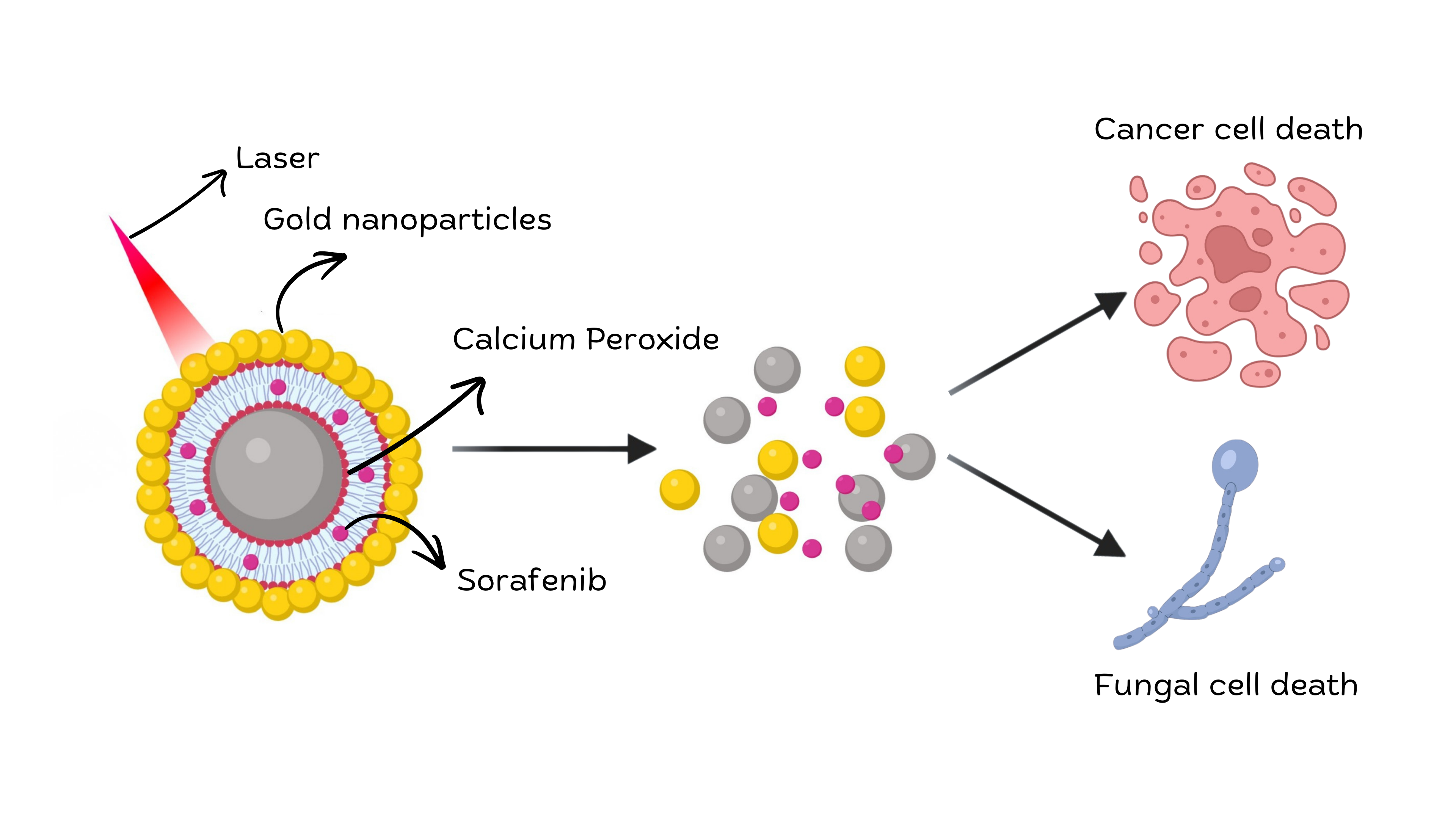
Multiple lines of treatment packed within gold-coated nanoparticles may enable localised cancer treatment, finds a recent study involving researchers from IIT Hyderabad and CSIR-IICT Hyderabad.
Cancers are difficult to treat as current methods of therapy cause collateral damage to healthy tissues. This calls for alternatives to target cancer cells more precisely. Gold nanoparticles offer a promising solution, as their optical properties enable the localised release of heat when a laser is focused on them. Gold nanoparticles are also chemically tunable, where a wide range of drugs can be packed within them.
Using lab-based experiments, a recent study demonstrates that gold-coated nanoparticles carrying a combination of drugs are effective in treating a type of skin cancer called melanoma, and fungal infections. This collaborative study was carried out by Dr Aravind Kumar Rengan’s group in IITH and Dr Chittaranjan Patra’s lab at CSIR-Indian Institute of Chemical Technology Hyderabad. Their findings open up possibilities of affordable localised therapy using multiple lines of treatment that attack cancer cells and co-occurring microbial infections.
The team tested the effect of two drugs, calcium peroxide and sorafenib, encapsulated within gold nanoparticles in cancer cell lines. Calcium peroxide produces molecules called reactive oxygen species, which degrade crucial biomolecules within cells, while the drug Sorafenib disrupts key cell signaling pathways and iron metabolism. When exposed to a near-infrared laser, the nanoparticles release the drugs locally, allowing the researchers to compare treatment outcomes with and without drug loading and laser activation.
The research team found that there was a significant drop in the survival of cancer cells treated with gold nanoparticles carrying both the drugs and activated with laser. It led to marked loss of structure in cancer cells, early death, and prevented their reappearance. Further lab investigation revealed that this treatment was also effective in attacking more complex clusters of cancer cells, impeding the formation of blood vessels that sustain tumours, and activating immune cells. The treatment also worked against fungal cells, which often cause infections in cancer patients with lowered immunity.
“Our lab works on nanomedicines for cancer therapeutics which target specific tumour sites,” says Rengan. These nanomaterials selectively accumulate in tumours, which can help in cancer diagnosis. Importantly, they also transform into therapeutic agents when activated by an external trigger, such as light or ultrasound, which can effectively kill cancer cells. “Through this, we can achieve an affordable way of targeting tumour cells,”, while also tackling the delay between detecting and treating cancer, he adds.
Reference: Sankaranarayanan, S. A., Srivastava, R., Eswar, K., Tripathy, S., Nagchowdhury, P., Rao, M. J., Patra, C., & Rengan, A. K. (2026). Development of gold coated calcium peroxide nanoparticles for photothermal ferroptosis against skin cancer and C. albicans. Communications Chemistry. https://doi.org/10.1038/s42004-025-01878-4