Democratising artificial intelligence and imagining the future of work
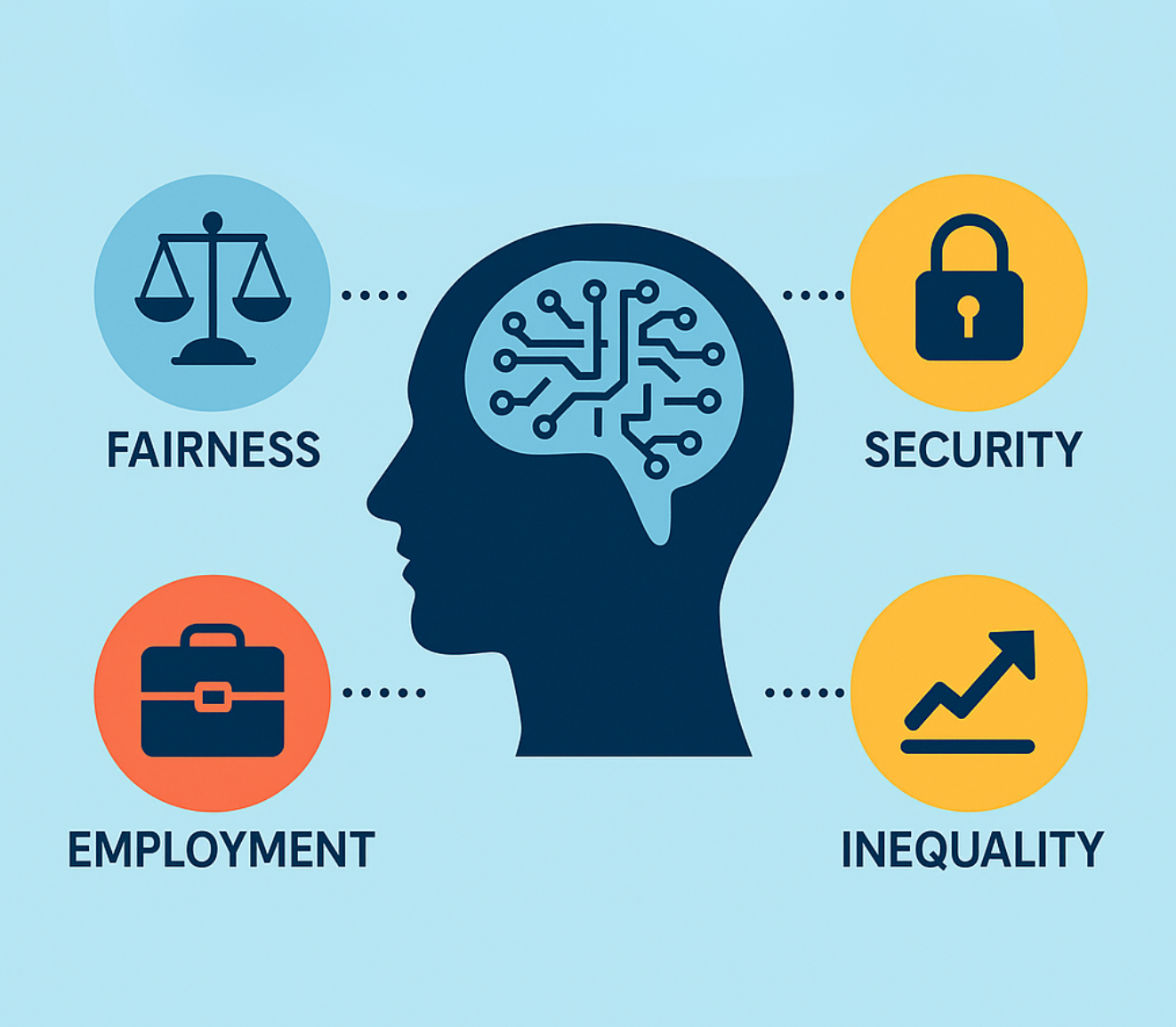
As the new year began, the campus was abuzz with conversations about artificial intelligence. Not the technicalities of computer algorithms and architecture, but broader questions about inclusivity, societal adoption, and the future of work.
Leaders from academia and industry came together for a dialogue on AI inclusivity and societal adoption in a conclave on January 16, 2026, leading up to the India AI Impact Summit by the Ministry of Electronics and Information Technology (MeitY). In this pre-summit event, Prof Sumohana Channappayya (IIT Hyderabad) steered a conversation on the meaning of AI inclusivity and the trade-offs between innovation and regulation, and Prof Vineeth N Balasubramanian (IIT Hyderabad) moderated a discussion on the societal adoption of AI with a focus on healthcare.
On the heels of this forum, Prof Pramod Khargonekar, a Distinguished Professor of Electrical Engineering and Computer Science at the University of California, Irvine, offered a peek at an informed imagination of work under AI as a part of an Extra Mural Lecture on January 19, 2026.
Balancing innovation and regulation
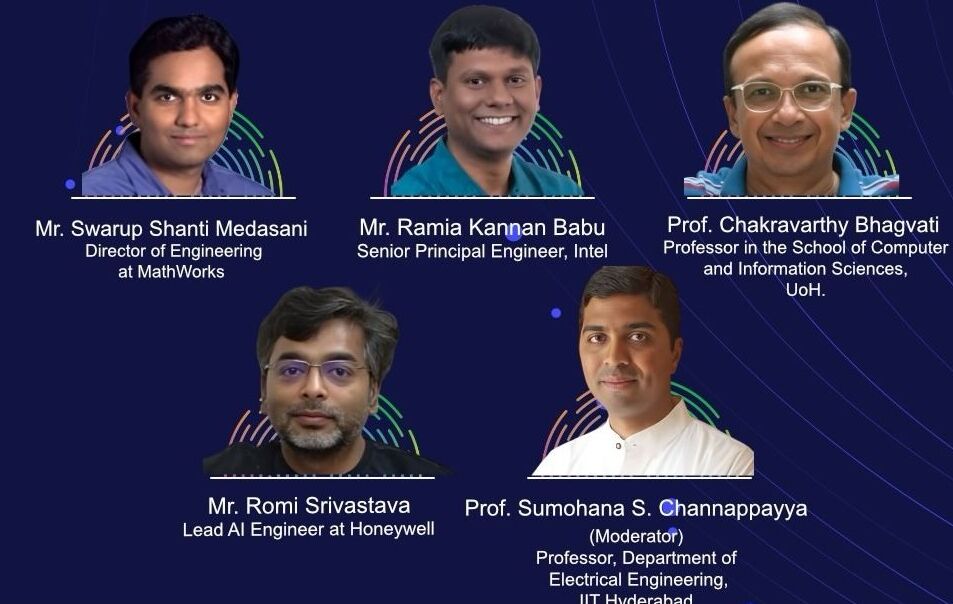
Exchanging thoughts on the meaning of AI inclusivity, panelists from industry and academia concurred that inclusivity is access to the use of AI tools and also the ability to develop them by people from all sections of society.
“Compute is owned by a few entities, and that is a barrier,” said Dr Swarup Medasani from Mathworks. Intel’s Kannan Babu added that when technology is made available to everyone, inclusivity follows naturally. Romi Srivastava from Honeywell emphasized that it is important to involve the people for whom the technology is meant in the development pipeline. The panelists pointed out the potential of AI on the Edge to democratize technology by allowing us to run models on local devices, creating a level playing field for developers, even from small towns and villages.
On AI governance, the panelists stressed the need for standards and accountability, while cautioning that stringent regulation in these early stages can slow the evolution of AI. It may not always be clear how technology being developed for a specific purpose will be used in the future at the development stage, clarified Babu. “We learn along the way and will recognise what guardrails are critical, which is beginning to happen now,” added Prof Bhagavati Chakravarthy from the University of Hyderabad. They batted for putting out technology as it develops, while striving to make improvements on the go.
Looking into the future, the experts predicted that a large population of producers and consumers, a nurturing AI ecosystem, and the scale and diversity of problems that need to be solved, positions India to develop solutions that can be taken to the rest of the world. According to them, the next big steps are building architecture to run AI models on small devices, consolidating the exponential advances in technology in recent years, developing greener AI, and improving model explainability to users.
An eye on societal challenges
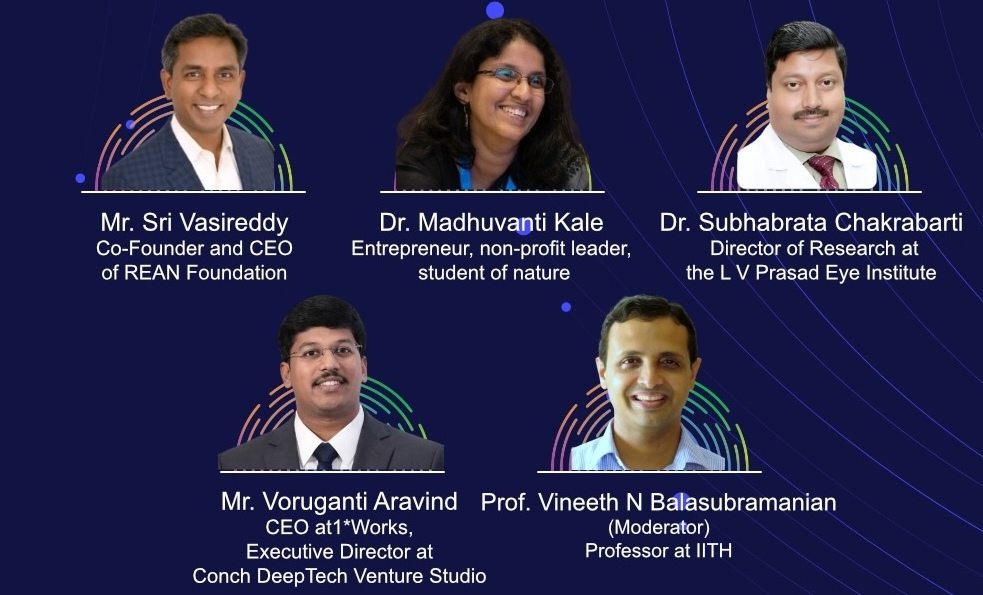
Speaking about the adoption of AI in healthcare and societal applications, entrepreneurs highlighted the need to be cognisant of societal nuances, empowering people and incentivising their participation in developing technology.
As an example of societal challenges, Sri Vasireddy from the REAN Foundation explained how even the best systems for diagnosis and treatment will not eradicate disease if patients fall off medical advice. Speaking of India’s vast unorganised working sector, Dr Madhuvanti Kale from United Way emphasised on the need to improve access and to empower and build trust when applying AI solutions. Dr Subhabrata Chakrabarti from LV Prasad Eye Institute stressed the need to understand the dynamics of supply and demand in healthcare and the nature of data used in AI models.
The panelists noted that these challenges present opportunities for India to develop AI tools driven by cultural attributes, enhancing work without replacing people, and valuing people’s participation in creating AI-based solutions. Along the way, regulation is important, but one has to move away from the negative connotation it carries by creating incentives, and be wary of applying blanket regulatory measures as a knee-jerk reaction, they explained. Voruganti Aravind from 1*Works India, shared his views on how governance can be locally built into the system by borrowing ideas from blockchain technology.
Concluding the discussion, panelists shared their dreams for the future of AI. They envisioned a “UPI-like” system for accessing and tracking health records, the ability to classify people for early and efficient health intervention, improving agricultural productivity, and building a team of people who can work towards a common goal from anywhere in the world.
Imagining the future of work
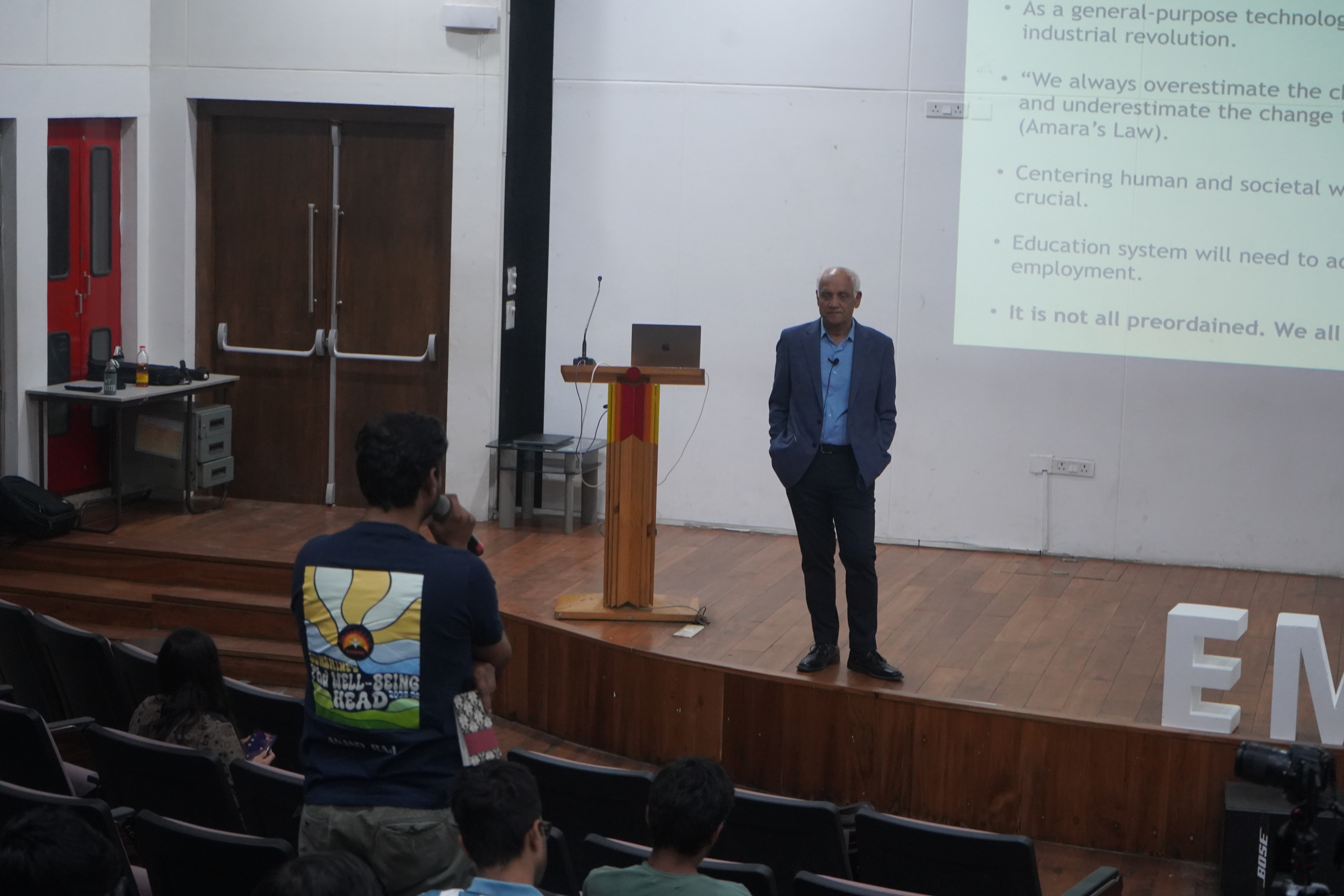
Panning between the past and the present and peering into the future, Prof Pramod Khargonekar spoke about useful frameworks that can help us imagine the future of work under AI.
In a thought experiment supported by extensive research, Prof Khargonekar discussed analogues from the past, which can serve as models to predict how AI will impact work and human workers. He placed his bets on artificial intelligence emerging as a General-Purpose Technology, which is widespread, one-of-a-kind, constantly improving, and inspires innovation, much like the advent of electricity or the printing press.
Drawing from current research, he said that up to a third of work that humans perform today will be automated by the end of this decade. While this significantly changes the nature of tasks we perform, it also opens new avenues. He emphasised that while we limit our thinking to human tasks that can be replaced by technology, a whole world of possibilities outside human-centric work remains to be imagined. These opportunities for augmenting work require social and emotional skills that are often missing in engineering education, he added.
When newer work opportunities arise, he warned of imbalances in access, where generative AI will be used largely by educated, well-paid workers engaging in creative work. However, entry-level jobs are likely to shrink drastically, which will impact students entering the workforce. The demand for physical labour will similarly wane as the rise of robots leads to greater automation.
Despite these warnings, Prof Khargonekar said he remains a techno-optimist, where he imagines AI as a “thought partner”, a collaborator which helps us find solutions to humanity’s most pressing problems.
–
These conversations underscore the need to consider the systemic impact of AI on society, and to imagine a future in which technological innovation is balanced by access and inclusivity, and technology augments work, enhancing the abilities of the human workforce.